7 Mistakes You’re Making with Wheel Alignment (and How to Fix Them)
Imagine you’re cruising down the 401, heading back into Ingersoll after a long day. You’ve got your favorite playlist going, the coffee is still warm, and life is good, until you realize you’re in a low-stakes wrestling match with your steering wheel. Your car desperately wants to veer toward the ditch, and you’re forced to maintain a constant “9 and 3” grip just to stay in your lane.
It starts as a minor annoyance, like a pebble in your shoe. But before you know it, you’re looking at a set of bald tires that should have lasted another three years. Welcome to the world of wheel misalignment.
At Butterworth’s Service Centre Inc., we see it all the time. People often treat wheel alignment like a dental check-up: they know they should do it, but they wait until something hurts. In the automotive world, “hurting” means a $1,000 bill for new rubber and a car that handles like a shopping cart with a broken caster.
To help you keep your ride smooth and your wallet full, we’ve rounded up the seven biggest mistakes drivers make with wheel alignment, and, more importantly, how to fix them.
1. The “I’ll Just Hold the Wheel Tighter” Strategy
We’ve all been there. You notice a slight pull to the left, but you figure, “Eh, I can handle this. My forearms could use the workout anyway.”
Ignoring a minor pull is the number one mistake car owners make. That pull isn’t just a quirk of your car’s personality; it’s a cry for help. When your wheels aren’t pointing exactly where they should be, your tires aren’t rolling, they’re partially dragging. This creates a friction pattern called “feathering” or “scuffing.”
What to do?
If you feel your car drifting when you relax your grip on a flat road, or if your steering wheel is crooked when you’re driving straight, it’s time for a professional check. Don’t wait for the “weird noise” of tires scrubbing against the pavement. Get it to a shop like Butterworth’s Service Centre Inc. before that minor pull turns into a major repair bill.
2. Treating Alignment Like a “Once-in-a-Lifetime” Event
Some folks think that if they got an alignment when they bought the car in 2021, they’re set for life. If only!
The roads around Ingersoll and the surrounding Oxford County aren’t always kind. Between winter frost heaves, the occasional deep pothole, and those gravel backroads, your suspension takes a beating. Even a “minor” curb tap while parking at the grocery store can knock your toe or camber angles out of whack.

What to do?
Make wheel alignment a part of your annual maintenance routine. A good rule of thumb is to have it checked every 10,000 to 12,000 kilometers, usually every other oil change. Think of it like a quick posture check-up for your car. Keeping things straight ensures your tires and suspension live their longest, healthiest lives.
3. Forgetting Your Car’s “Brain” (Neglecting ADAS)
Modern cars are smarter than ever. Most vehicles built in the last few years are equipped with Advanced Driver Assistance Systems (ADAS). These are the “eyes” of your car, the cameras and sensors that handle lane-keep assist, automatic emergency braking, and adaptive cruise control.
Here’s the catch: these sensors are often calibrated based on the direction the wheels are pointing. If your alignment is off, or if a technician aligns the wheels but doesn’t recalibrate the ADAS, your car’s brain gets confused. It might think you’re drifting out of a lane when you aren’t, leading to jerky steering corrections that feel like a ghost is riding shotgun.
What to do?
Always ensure your service center has the technology to handle advanced systems. When you get an alignment, ask if your ADAS needs a reset. At Butterworth’s, we make sure the mechanical and the digital are in perfect harmony.
4. Falling for the “Front-End Only” Fallacy
Back in the day, a “front-end alignment” was the standard. But most modern cars, especially SUVs and performance vehicles, require a four-wheel alignment.
If your rear wheels are misaligned, your car might suffer from “dog-tracking.” This is when the rear of the car doesn’t follow directly behind the front, making the vehicle move down the road at a slight angle (like a dog running sideways). Not only does this look goofy, but it also ruins your handling and stability in the rain or snow.
What to do?
Always opt for a total four-wheel alignment. It ensures that all four corners are working together. When we perform an inspection and diagnostic check, we look at the whole picture, not just the front wheels.
5. Installing New Parts on a “Dirty” Foundation
We love DIY-ers, but a common mistake happens during home repairs of steering or suspension parts. If you replace a tie rod or a control arm and don’t immediately get an alignment, you’re asking for trouble.
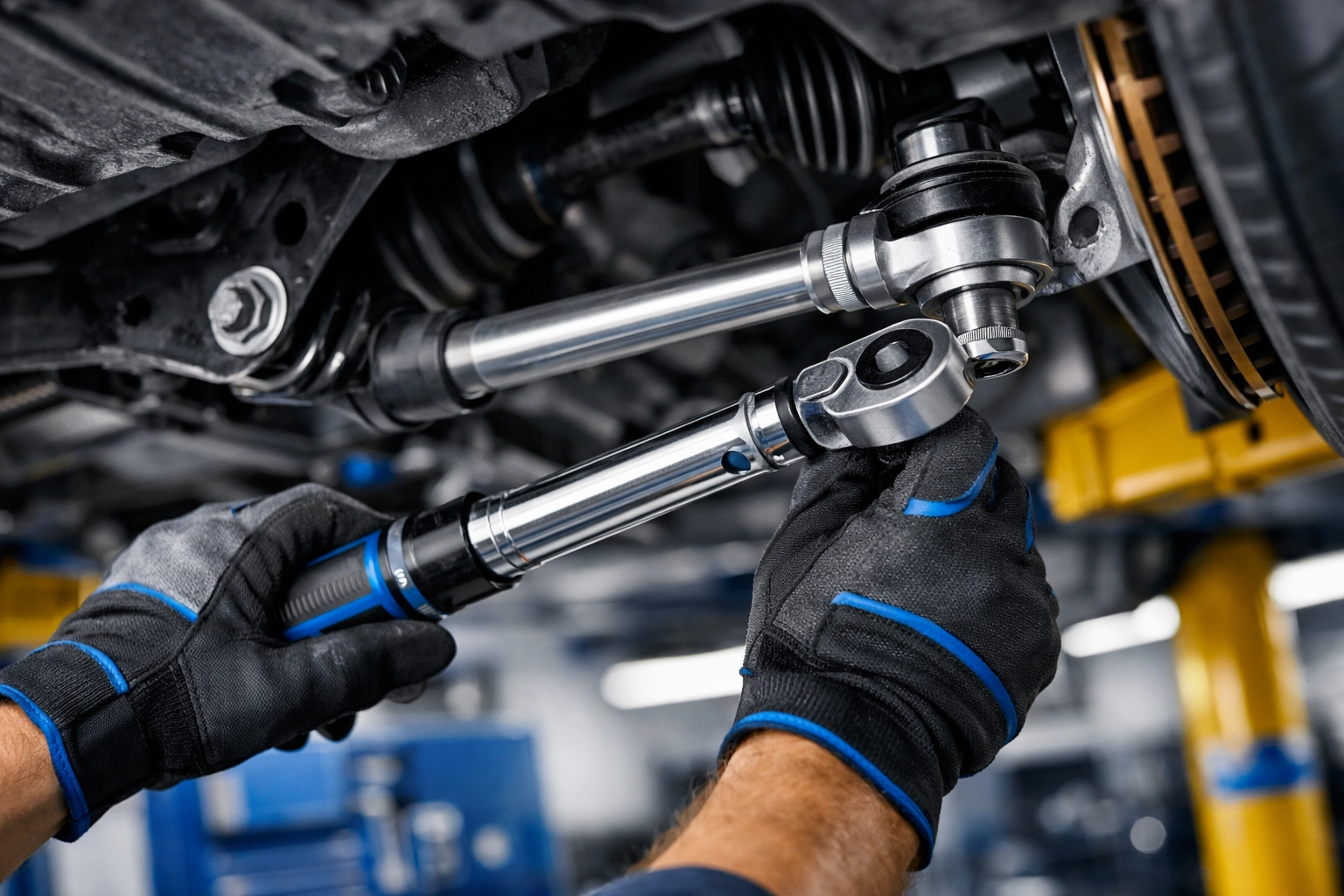
Furthermore, professional research shows that many errors occur during installation, like not fully tightening bolts until the vehicle is back on the ground, or reusing old, rusty hardware. If the parts aren’t installed perfectly, no amount of alignment “tweaking” will fix the underlying instability.
What to do?
If you’re replacing suspension components, do it in pairs (left and right) to ensure even wear. And the second that car comes off the jack stands, drive it straight to a pro. Better yet, let our experts handle the specialized services to ensure every bolt is torqued to factory specs.
6. Thinking “Close Enough” Is Good Enough
When it comes to alignment, we’re talking about fractions of a degree. You might think, “Oh, it’s only off by 3 millimeters, that’s nothing!”
Wrong. Being out of tolerance by just 3mm is the equivalent of dragging your tire sideways for half a meter for every single mile you drive. Over a trip from Ingersoll to Toronto, that’s like dragging your tire sideways across a few football fields. Can you imagine the heat and wear that generates? You can practically smell the money burning off your tread.
What to do?
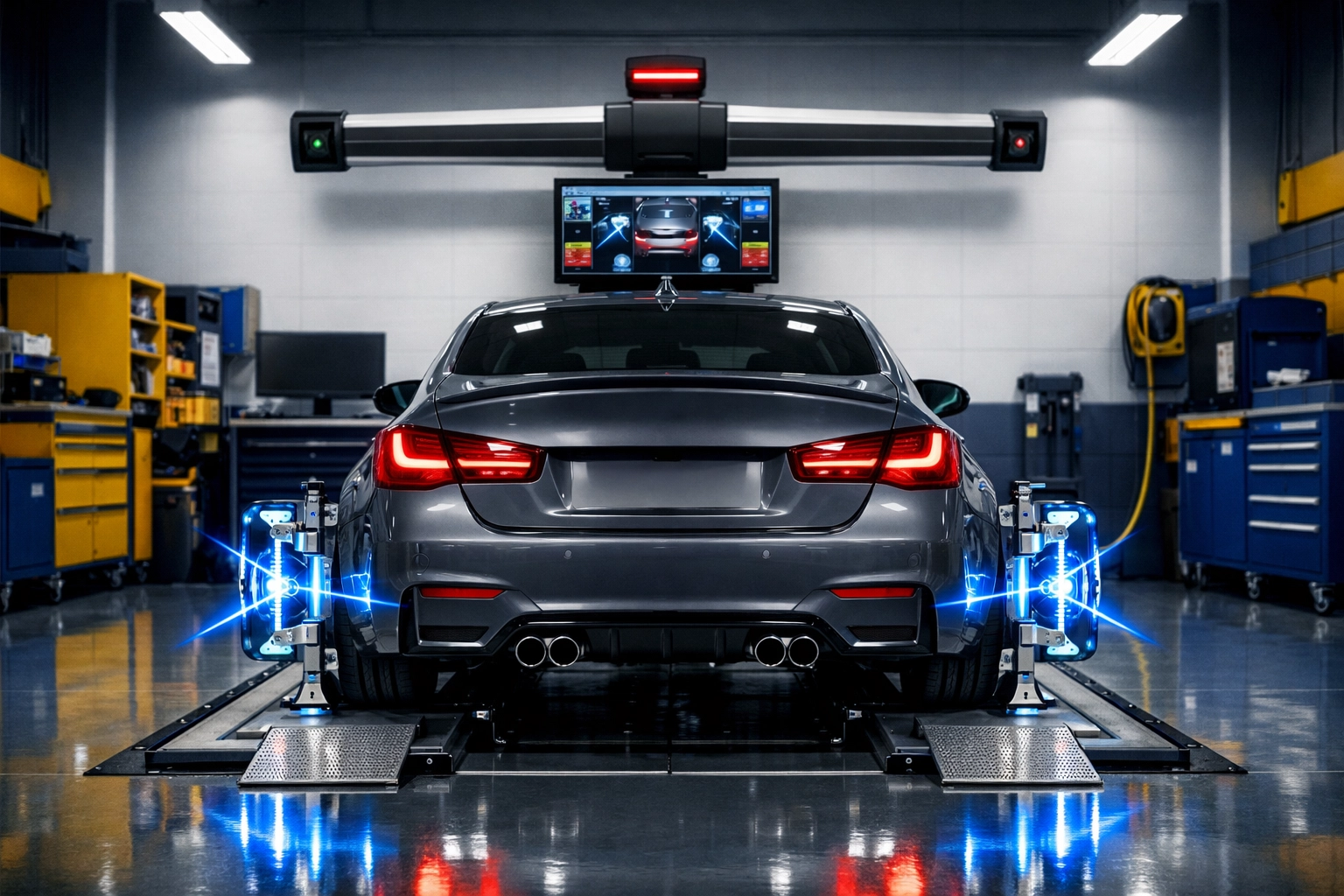
Don’t settle for “green enough” on a printout. Demand precision. Our high-tech alignment racks at Butterworth’s Service Centre Inc. allow us to dial in your vehicle’s specs with surgical accuracy. We don’t do “close enough”; we do “factory perfect.”
7. Choosing the “Budget” Shop Over a Trusted Partner
It’s tempting to go to the cheapest place in town for a quick alignment. But wheel alignment is as much an art as it is a science. A budget shop might just “toe-and-go”: meaning they only adjust the easiest angle and ignore the rest. They also might not have the training to spot worn-out bushings or ball joints that will make your alignment pop back out of place the moment you hit a speed bump.
What to do?
Go to a shop that stands behind its work. At Butterworth’s, we aren’t just looking for a quick fix; we’re looking to be your long-term automotive repair partners in Ingersoll. Plus, our work is backed by the NAPA Peace of Mind Warranty, which provides you with 12 months or 20,000 kilometers of worry-free protection across North America.
The Bottom Line: Save Your Tires, Save Your Sanity
Proper wheel alignment is about more than just a straight steering wheel. It’s about safety, fuel efficiency (less drag means better gas mileage!), and protecting the massive investment you’ve made in your tires.
Don’t let these common mistakes keep you from enjoying the drive. If your car feels “loose,” if your tires are squealing in the Tim Hortons drive-thru, or if you just can’t remember the last time you had your alignment checked, it’s time to act.
Ready to get things straightened out?
Stop by Butterworth’s Service Centre Inc. in Ingersoll. We’ll get you back on the straight and narrow so you can feel like a total boss behind the wheel again.